
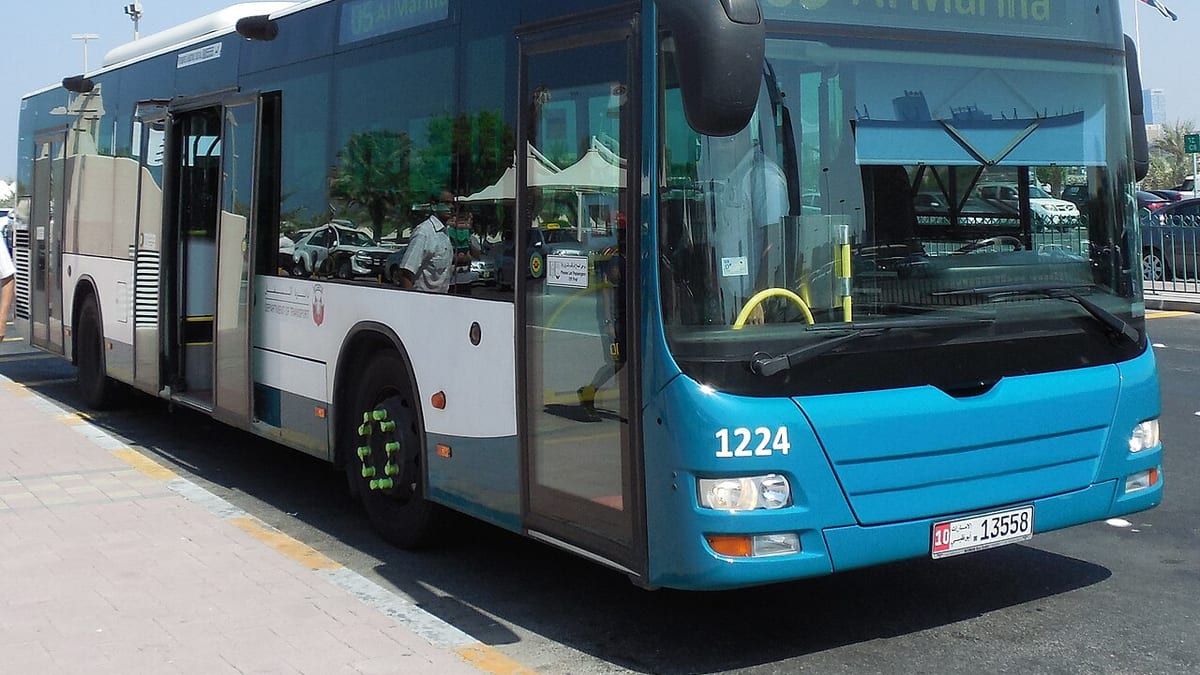
Abu Dhabi's standard city and suburban bus fare is AED 2 to board plus AED 0.05 per kilometre, capped at AED 5 per qualifying journey. Transfers can avoid another boarding charge when the published conditions are met. The useful unit for budgeting is therefore the complete journey, not simply the number of buses you board. 1
Those rules describe the standard service. They should not be applied automatically to intercity coaches, attraction shuttles or any other vehicle that happens to leave from a bus station.
What the fare formula means in practice
Five fils is AED 0.05. Under the published formula, a 10-kilometre standard journey would calculate as AED 2 plus AED 0.50, or AED 2.50. A 30-kilometre example would be AED 3.50. At 60 kilometres, the calculation reaches AED 5. These are arithmetic examples, not quotes for named routes. 1
The distance used by a bus service is not necessarily the straight line between two map pins. Roads, stops and the chosen route matter. Use the journey planner and the operator's displayed fare where available rather than multiplying a rough walking distance.
A longer route can still be the better choice when it avoids an awkward transfer. Conversely, a seemingly cheap direct bus may be poor value if it leaves you far from the entrance you actually need.
For a travel budget, write down outward and return journeys separately. A day at an attraction does not normally mean that the return trip several hours later is one continuous transfer chain.
The transfer rules have three conditions
The operator permits a transfer without a second AED 2 boarding fee when the next tap-in is within 60 minutes of the previous tap-out, the journey does not reverse direction, and you make no more than two transfers using three buses. The standard-service rules exclude intercity travel. 1
This is not a free hour of unlimited sightseeing. A transfer allowance exists to complete a journey, not to turn a series of unrelated errands into one fare. The direction condition matters as much as the time window.
Consider a hypothetical trip with one bus, a reasonable wait and a second bus continuing towards your destination. It may fit the transfer rules. Taking a bus out, stopping briefly, then returning towards the origin is a different pattern even if less than an hour has elapsed.
The absence of a second boarding fee also does not mean all subsequent distance becomes free. The fare is still associated with the eligible journey. The authority's explanation distinguishes the boarding charge from distance travelled. 2
Build a connection with enough margin to work in practice. A technically cheap route that depends on a near-instant transfer can become inconvenient if the first bus runs late.
Tap out even when you are changing buses
Hafilat must be used at both boarding and alighting. The authority warns that failing to record an exit can lead to a full-route deduction on the next use, because the system cannot correctly identify where the previous journey ended. 3
At an interchange, it is easy to focus on catching the next bus and forget the exit tap. Treat leaving the first bus and boarding the second as two separate actions.
If a reader does not confirm the tap, ask for help rather than assuming it recorded the journey. Keep the card accessible until the transaction is complete. For a family, establish which card belongs to whom before reaching the stop.
A balance that falls unexpectedly is not always evidence of an incorrect top-up. It may be connected to a previous incomplete journey. When asking staff to investigate, describe both the recent recharge and the last trips made.
Compare a pass with real journeys
The seven-day Hafilat pass costs AED 35 and the 30-day version AED 95 for eligible city and suburban travel. Their coverage excludes intercity services, and the operator ties validity to purchase. 4
Suppose your week contains eight eligible journeys at a calculated AED 3 each. That totals AED 24, below the weekly pass price. Twelve such journeys total AED 36, only slightly above it. The pass wins narrowly in the second example, but the convenience may also matter.
Now change the itinerary. If some travel is on a complimentary shuttle or in a shared taxi, those trips should not be counted as savings generated by the Hafilat pass. A product's value depends on the journeys it actually replaces.
Do not count every bus in a qualifying transfer chain as a new full-price journey. Doing so inflates the apparent benefit of a pass and can lead to purchasing more coverage than you need.
For a short stay, stored value often deserves consideration first. For frequent travel over the full validity period, the pass may simplify the trip as well as reduce cost.
Budget separately for the card and unused credit
A new anonymous Hafilat card has its own acquisition price, separate from the money or pass loaded onto it. Keep setup costs distinct from the fare calculation so you do not mistake the first day's higher spending for the cost of a single ride. 5
Likewise, money loaded onto the card is not necessarily money already spent on transport. Some remains prepaid until used. The operator does not offer refunds of remaining balance, making a modest, purposeful top-up preferable to loading a large amount for a brief visit. 6
For a group, estimate each fare-paying traveller's requirements instead of using one person's budget for everyone. Confirm any age-based entitlement with official instructions rather than assuming that a child travels free merely because another attraction considers them a child.
Keep a separate allowance for a taxi when time, luggage or the return route makes it worthwhile. A bus budget should help you plan, not force you into an unsuitable journey to avoid a small additional expense.
The fare is only one part of the decision
The airport's bus page gives an approximate fare for its services, but a general estimate should not override the standard formula or a current route-specific quotation. Match the actual destination and service before deciding what to load. 7
The best comparison is door to door: the fare, walking distance, waiting time and number of changes. A direct bus with a short walk can be excellent value. A chain of buses followed by a long exposed walk may be less attractive, even when the fare remains low.
Use Hafilat correctly, distinguish standard journeys from other services and calculate a pass against a credible itinerary. Once those three points are clear, Abu Dhabi's bus fares become much easier to understand without memorising a separate price for every destination.
Sources
- Abu Dhabi Mobility: public bus fares
- Abu Dhabi Mobility: standardised bus tariffs
- Abu Dhabi Mobility: how to use Hafilat
- Abu Dhabi Mobility: public transport passes
- Abu Dhabi Mobility: anonymous Hafilat card
- Abu Dhabi Mobility: replacements, transfers and refunds
- Zayed International Airport: city bus services