
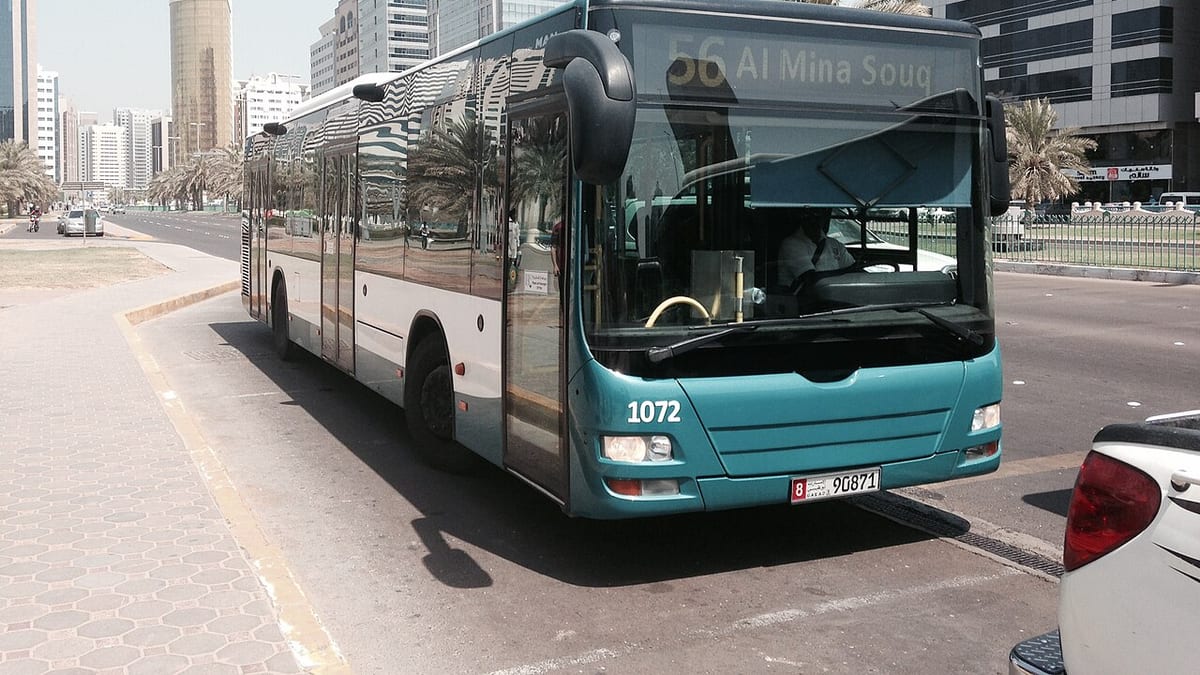
Use the Abu Dhabi bus map as a journey-planning tool, not as a list of route numbers to memorise. Start with your exact hotel and attraction entrance, choose the travel time, and check the direction and return connection. Darbi is the transport authority's journey-planning service; official airport and attraction pages provide useful checks on the routes most visitors need. 1
The best route is the one that works door to door. A line passing near a landmark can still leave an inconvenient walk, a road crossing or a transfer that makes another option preferable.
Read a trip in four parts
For every proposed journey, identify the walk to the first stop, the correct bus direction, any interchange and the walk from the final stop. This is more useful than looking only at the coloured line on a network diagram.
Use a specific entrance or address. "Corniche," "Yas Island" and "Saadiyat" cover more than a single pickup point. A route that reaches the general area may not bring you close to the restaurant, museum door or hotel lobby you need.
Darbi's official app description says it offers journey planning, bus-schedule information and transport-related services. Use it with your intended departure time rather than assuming that a route found for midday will be equally convenient late at night. 2
Save the proposed stops and the return plan before leaving reliable internet access. A screenshot is a useful backup, but recheck the live information when it matters: a saved image cannot show a later service change.
Airport routes are not interchangeable
Zayed International Airport lists A1 towards Al Zahiyah, A2 towards Khalifa Street, A10 towards Mohammed Bin Zayed City and A40 towards Al Shahama, among other services. These destinations are different parts of the network, not alternative names for a single "city centre" bus. 3
Choose the route by the hotel's location and the final walk. A bus with a familiar destination name can still be the wrong choice if it leaves you on the opposite side of the city from your accommodation.
The airport says A-series buses operate 24 hours, but this does not mean every route anywhere in Abu Dhabi runs continuously or at the same frequency. Check the actual service you intend to use and the next available departure. 3
For a first arrival with luggage, prefer fewer changes when the total cost remains reasonable. The extra simplicity may be worth more than a small saving, particularly when you do not yet recognise the interchange.
Use attraction pages to confirm the last connection
Louvre Abu Dhabi's own visitor page identifies city bus 94 as an access option. That is a useful cross-check when planning a museum trip: search for the actual museum stop and confirm the route at the time you intend to travel. 4
Do not assume that reaching Saadiyat Island means every cultural venue is a short walk away. Check each entrance separately and review the pedestrian route, especially when combining several attractions in one day.
For the Corniche, identify the section you want to walk. The tourism authority describes an eight-kilometre waterfront, so "the Corniche stop" is not a sufficiently precise plan. Pick an access point that fits your intended walk and return journey. 5
For a large shopping centre or event venue, use the entrance named by the operator. A map pin in the middle of a large property may not represent the door pedestrians can reach from the road.
These small checks often matter more than learning another route number. The bus gets you to a stop; your plan must still get you from the stop to the experience.
Know when you are changing systems
Yas Express is a separate complimentary island shuttle. Its current directions page carries an island-only operating notice, so an old airport or Dubai shuttle diagram should not be treated as the current public-bus network. 6
A public bus, an attraction shuttle and a hotel transfer may appear together in a travel search, but their ticketing, eligibility and operating hours can differ. Label each leg in your plan by operator.
Likewise, Darbi and Darb are not identical services. Abu Dhabi Mobility identifies Darbi with journey planning and Darb with road tolling. Searching for the wrong name can lead a visitor into a vehicle-payment service rather than bus directions. 1
When a hotel says it has a shuttle, ask for its destination and schedule. A shopping shuttle or beach transfer is not necessarily a connection to the nearest public-bus interchange.
Interchanges require direction and timing checks
At a change of bus, confirm the stop on the correct side of the road and the route's destination display. The same road may have stops serving opposite directions, and the shortest map line is not always the pedestrian crossing route.
Allow time to move between stops. A connection that looks immediate in a journey planner may still involve a crossing, stairs or a walk around a large junction.
The standard fare rules allow qualifying transfers without another boarding charge, but include a time window, direction condition and limit on the number of changes. Fare integration is therefore not a reason to ignore the practical difficulty of an interchange. 7
For a sightseeing day, I recommend prioritising a direct service when it gives a reasonably close arrival. A slightly longer ride can be easier than changing buses in an unfamiliar area, particularly with children.
Check the return direction separately. A useful outbound stop does not prove that the reverse stop sits directly opposite the entrance.
A map can reveal a better kind of outing
The authority describes service 73 as connecting Al Reem Island and Al Hudayriat Island with dedicated bicycle space. That illustrates why a current route description can be more useful than a generic city map: it tells you something about the service itself, not just its line on the page. 8
For any specialised journey, verify the relevant condition before travelling. Bicycle accommodation, accessible boarding and luggage arrangements should not be assumed to apply identically across every service.
Build a day around a small number of geographically compatible stops. A map is most useful when it helps you remove unnecessary cross-city travel, not when it persuades you to include every attraction it displays.
Before setting out, you should be able to state the plan in one sentence: walk to this stop, take this bus in this direction, leave at this stop and use this entrance. Add a clear return option and usable Hafilat credit. That is a workable bus itinerary, even if you never memorise the whole network.
Sources
- Abu Dhabi Mobility: Darbi journey planner
- Darbi: official application description
- Zayed International Airport: city bus services
- Louvre Abu Dhabi: visit, admission and hours
- Experience Abu Dhabi: Corniche
- Yas Island: getting to and around the island
- Abu Dhabi Mobility: public bus fares
- Abu Dhabi Mobility: bus service 73