
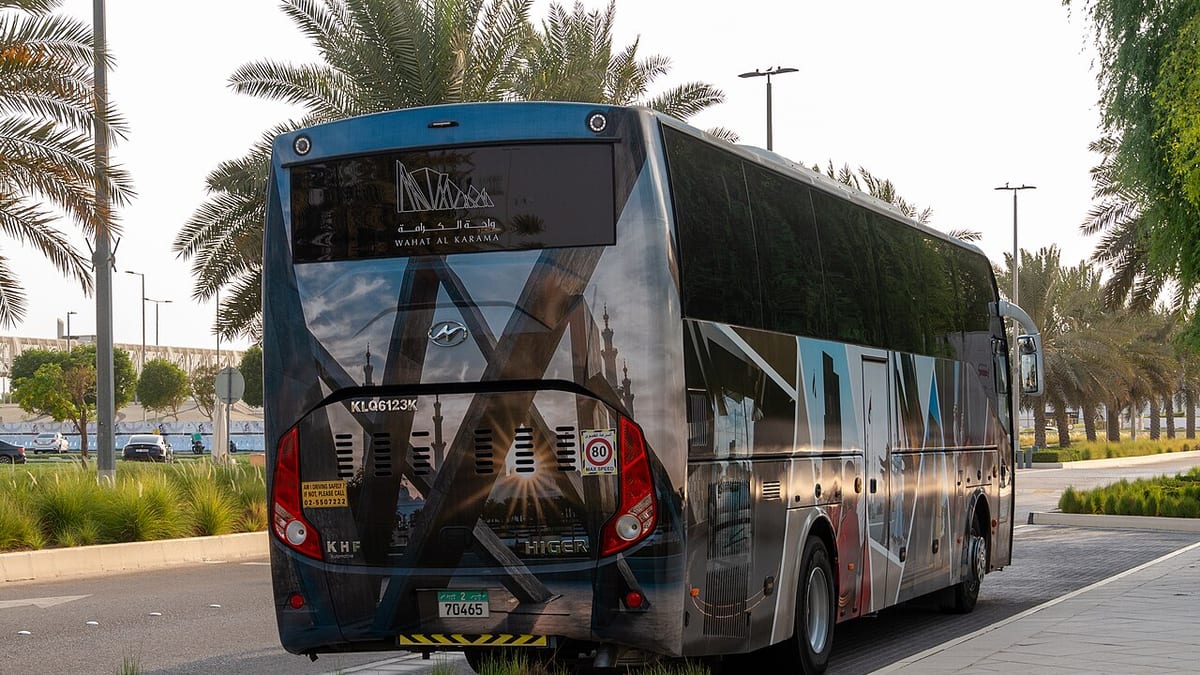
For Abu Dhabi's public buses, prepare a Hafilat card rather than assuming you can tap a contactless bank card or a phone wallet. Hafilat itself is contactless, but that does not make it a Visa or Mastercard payment system. Current official visitor instructions still tell passengers to use Hafilat; the airport also says cash is not accepted on board. 12
That terminology is the source of much confusion. "Tap to pay" can describe a prepaid transport card, a bank card or a phone containing either one. What matters is which payment product the bus accepts, not whether you physically touch the reader.
Contactless does not necessarily mean your bank card
Abu Dhabi Mobility describes Hafilat as the card used to pay public-bus fares. Its instructions require a tap when boarding and another when leaving. The journey is recorded against that transport card, with the applicable fare deducted from its balance. 3
A bank card used to purchase or recharge a transport product is performing a different job. Paying at a machine does not establish that the same bank card can be held against the bus validator. The purchase channel and the travel payment system should not be confused.
The same caution applies to a phone. Having Apple Pay or another wallet enabled does not, by itself, mean the bus reader accepts it. Unless the operator specifically confirms an accepted product for your service, arrive with the transport card described in the official instructions.
This is a practical planning recommendation, not a claim that no payment technology can ever change. At the research date, the official pages reviewed did not establish general open-loop bank-card acceptance on ordinary Abu Dhabi public buses.
What to do when arriving at the airport
Zayed International Airport says Hafilat cards can be purchased and topped up at ticket machines near the bus stops. Its public-bus information identifies routes to different city areas, so first select the route that serves your accommodation rather than simply boarding the first bus marked for Abu Dhabi. 2
Before walking to the stop, have the hotel's full address or map pin available. A hotel described as "city centre" may not be near the endpoint you have chosen. Compare the last walk from the stop with the practical alternative of a taxi, especially with luggage.
At the machine, separate the card purchase from the amount loaded for travel. A new card is not necessarily supplied with enough usable credit for every planned journey. Read the confirmation and keep the receipt until the first successful trip.
Do not rely on the driver to sell a ticket for cash. If the machine is unavailable or you are unsure what it has issued, resolve that before boarding through airport or transport staff. A flight arrival is not the ideal moment to experiment with an unconfirmed payment method.
Buying a visitor card without a resident account
The operator lists an anonymous Hafilat card at AED 10 and says it can be obtained without prerequisites. That makes it the straightforward product to investigate for a short visit, rather than assuming you need an Emirates ID or a personalised resident account. 4
Buy it from an official machine, transport office or an outlet listed by the operator. Use a modest initial travel balance rather than loading the maximum because the machine offers it. Estimate your actual journeys first.
For a family or group, ask staff which card arrangement applies to each fare-paying passenger. Do not assume one card can be repeatedly tapped for several adults merely because that works in another city. The card records entry and exit events, so improvising shared use can create confusion.
Keep the card separate from other contactless cards when presenting it. You want the intended card to be read clearly, not a wallet containing several possible products. After boarding, put it somewhere you can reach again at the exit.
How to use it without an incomplete journey
Tap the card at boarding, look for confirmation, and tap again when alighting. Abu Dhabi Mobility warns that a missed exit tap can cause a full-route deduction on the next use. It is therefore worth paying attention even when the bus is busy or you are concentrating on getting luggage off. 3
If the reader rejects the card, do not treat the sound as a successful transaction. Ask the driver or staff what the display indicates. The useful distinction is whether the problem concerns insufficient credit, the card itself or an incomplete previous journey.
When changing buses, repeat the process on each vehicle. A transfer is still a separate boarding and alighting event even when fare rules recognise the whole trip as one qualifying journey. Holding onto the same card is simpler than trying to change payment methods halfway.
For children or companions who need help, agree who will keep each card before the bus arrives. Sorting a stack of nearly identical cards at the exit is an avoidable source of stress.
Recharge before you need the balance
The operator distinguishes immediate credit at its sales or recharge machines and service offices from a two-hour reflection period for website and MBME recharges. A payment confirmation on your phone is therefore not always proof that the bus can immediately use the new credit. 5
For a bus leaving soon, an official machine that writes the balance immediately is the more dependable choice. For a later outing, online recharge can be convenient, provided you allow the published processing period and retain the transaction reference.
Do not make repeated payments simply because a balance has not appeared instantly. Check the card number, the channel used and the elapsed time first. Multiple successful purchases can leave you with more prepaid credit than you intended.
Not every bus-shaped service is the same system
Yas Express is described as a complimentary island shuttle, while the ordinary public network uses Hafilat. A hotel shuttle, attraction bus or intercity service may have its own conditions. The vehicle's appearance is not enough to identify the payment rule. 61
Ask three questions before travelling: who operates the service, whether it requires a ticket or entitlement, and whether your proposed payment method is explicitly accepted. This is more reliable than asking only whether it is "contactless."
For an ordinary city-bus journey, the preparation is simple: the correct Hafilat card, usable balance and a tap at both ends. Keep a separate payment option for a taxi or an unexpected change of plan, but do not confuse that backup with a confirmed way to pay the bus fare.