For a first Abu Dhabi self-guided walking tour, keep the route compact: explore Al Hosn, continue to the World Trade Center Souk, then finish at the Corniche. This connects history, craft, shopping and the waterfront without pretending the city's major islands and landmarks are all walkable together. Allow a flexible half-day, and shorten the outdoor sections when conditions are uncomfortable.
Before setting off: choose what you will enter
The route's main cultural stop is the Al Hosn precinct. It includes Qasr Al Hosn, the House of Artisans and the Cultural Foundation, but they should not be treated as one undifferentiated admission product. Qasr Al Hosn's visitor information states that the House of Artisans, Cultural Foundation and surrounding landscape are freely accessible; the fort visit and separately organised activities have their own arrangements. 1
Choose your museum depth before estimating the walk. Someone viewing the precinct and taking a short craft stop will have a different day from someone entering the fort and attending a workshop. The physical distance is only one part of the itinerary.
Ordinary fort hours currently run from 9am to 8pm Saturday to Thursday and from 2pm to 8pm on Friday. A Friday morning route can therefore begin with another part of the area, but it should not promise an early fort visit. Special events can change access, so use the ticket's date-specific instructions when a festival is operating. 1
Wear shoes suitable for sustained pavement walking and bring the essentials you need without carrying a day's shopping from the start. The route is deliberately not a race. Outdoor comfort and the group's pace should determine how much you do on foot.
Begin at Qasr Al Hosn, then move through the precinct
Start with the fort if its history is your main reason for coming. Its position within the Al Hosn site makes it a natural introduction before you turn to the neighbouring craft and cultural spaces. Use the official entrance instructions rather than following a map pin to whichever side of the building appears nearest. 1
Inside a museum visit, select the elements that answer your own questions about Abu Dhabi's development. You do not need to read every display to make the stop worthwhile. Leave time afterwards to look at the relationship between the fort and the surrounding contemporary city.
Continue to the House of Artisans. The UAE cultural map connects its craft traditions with the environments in which they developed: desert, oasis, coast and sea. That provides a useful way to look at materials and techniques rather than treating the stop as a generic souvenir display. 2
At the Cultural Foundation, let the current exhibition or activity programme decide how long you stay. Free access to a cultural building does not imply that every workshop is available without registration. If a booked session is central to your day, move the rest of the route around it rather than trying to squeeze it into a fixed walking schedule. 1
A reasonable planning approach is to give the precinct the largest share of the morning or afternoon. This is the part of the route where you can most easily add meaningful depth without adding another long journey.
Continue to the World Trade Center Souk
From Al Hosn, use a pedestrian route towards the World Trade Center Souk, checking the actual crossings rather than drawing a straight line across the road grid. The operator places the souk on Khalifa Bin Zayed the First Street, close to the Corniche. Save its proper entrance pin so that you do not mistake the wider complex for a single doorway. 3
The souk is a contemporary shopping destination, not an untouched historic market. That distinction is useful: you can enjoy its interpretation of a market setting without expecting every shop to represent an old local craft business. 3
Browse with a specific question in mind. Are you interested in textiles, fragrance, jewellery or a small food purchase? Ask where an item was made and what the stated material means. The location of a shop alone is not evidence that everything inside it was produced in the UAE.
This is a practical point for a meal or an indoor pause. Before sitting down, decide whether the Corniche remains your next destination or whether the group has already had a satisfying day. Ending a walk at the souk is a valid choice; completing every stop is not a condition of enjoying the route.
Keep larger purchases until the end where possible. Carrying bags changes the appeal of an otherwise comfortable waterfront walk, particularly when the group has already spent several hours inside the precinct.
Finish at the Corniche, not at an arbitrary distant landmark
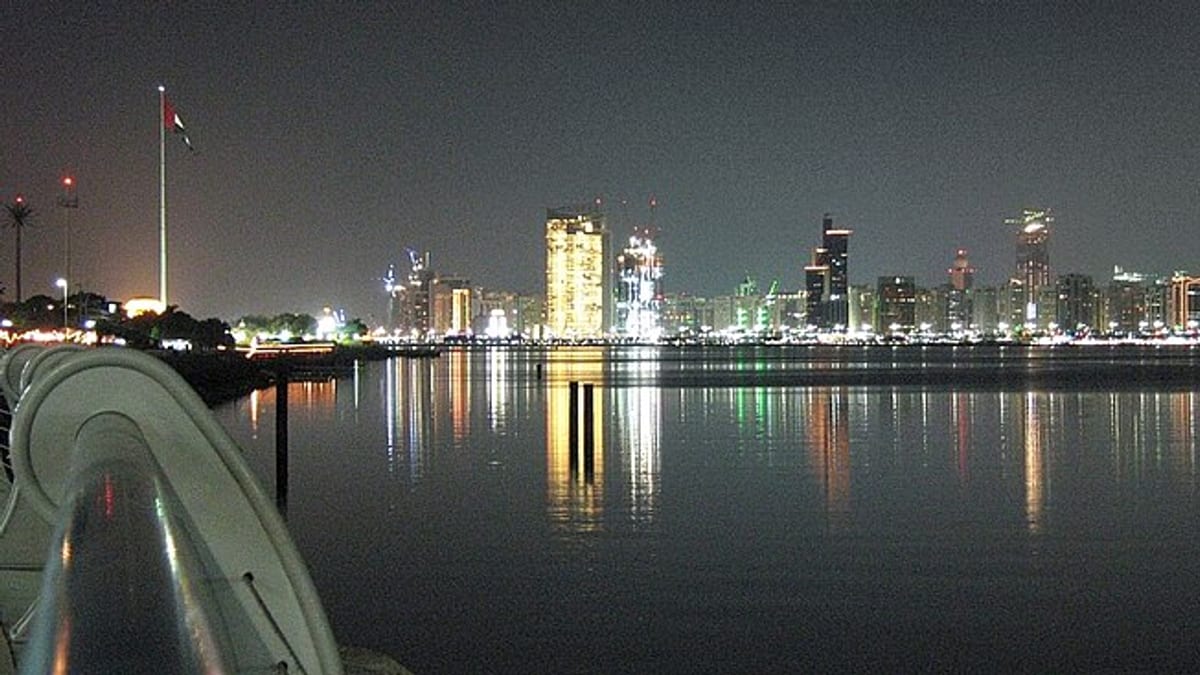
Continue towards the Corniche using a mapped pedestrian route with marked crossings. Abu Dhabi's tourism authority presents the Corniche as a waterfront destination with walking and recreational space. The point of this final section is the change in setting from the cultural precinct and shops to the sea, not an obligation to cover the entire waterfront. 4
Choose a short section and a clear endpoint before setting off. That might be a convenient pickup point, a place to sit or a meal reservation. A promenade that extends beyond your immediate view is not an invitation to keep walking until everyone is tired.
Do not confuse promenade access with admission to every beach area or facility. Read local signs when leaving the public walking route, and carry suitable clothing for the activity you actually intend to do. A sightseeing walk does not need to become an unplanned beach day.
Late in the day, this section can provide a pleasant finish, but visibility, weather and your energy matter more than a prescribed photo time. Choose the moment for the experience rather than assuming a particular view or sunset colour is guaranteed.
The Sheikh Zayed Grand Mosque, Louvre Abu Dhabi and Yas Island should be separate journeys, not extensions of this walking route. Adding them changes the plan from a compact city walk into a multi-stop transport day. Keep the two types of itinerary distinct.
Distance, accessibility and sensible shortcuts
Treat approximately three to four kilometres as a planning envelope for the connecting walk and local exploration, not a surveyed track. Your total will depend on entrances, crossings and how much you move within the precinct and shops. Museum interiors add time and steps that a simple point-to-point map does not capture.
For accessibility, verify the route segment by segment. Accessible buildings do not guarantee that every connecting pavement, crossing or temporary festival diversion will suit every visitor. Ask the venue about its appropriate drop-off and entrance, then use a vehicle for any connection that would undermine the outing.
The simplest shortcut is to take transport between the Al Hosn precinct and the waterfront, retaining the places you most want to experience while removing the least interesting connection. Another is to make the souk your finish and return to the Corniche on a separate evening.
The route works because it gives each stop a different role: Al Hosn for history and craft, the souk for browsing and a break, and the Corniche for open waterfront space. Let those roles guide your choices, and the day remains coherent even when you shorten it.