
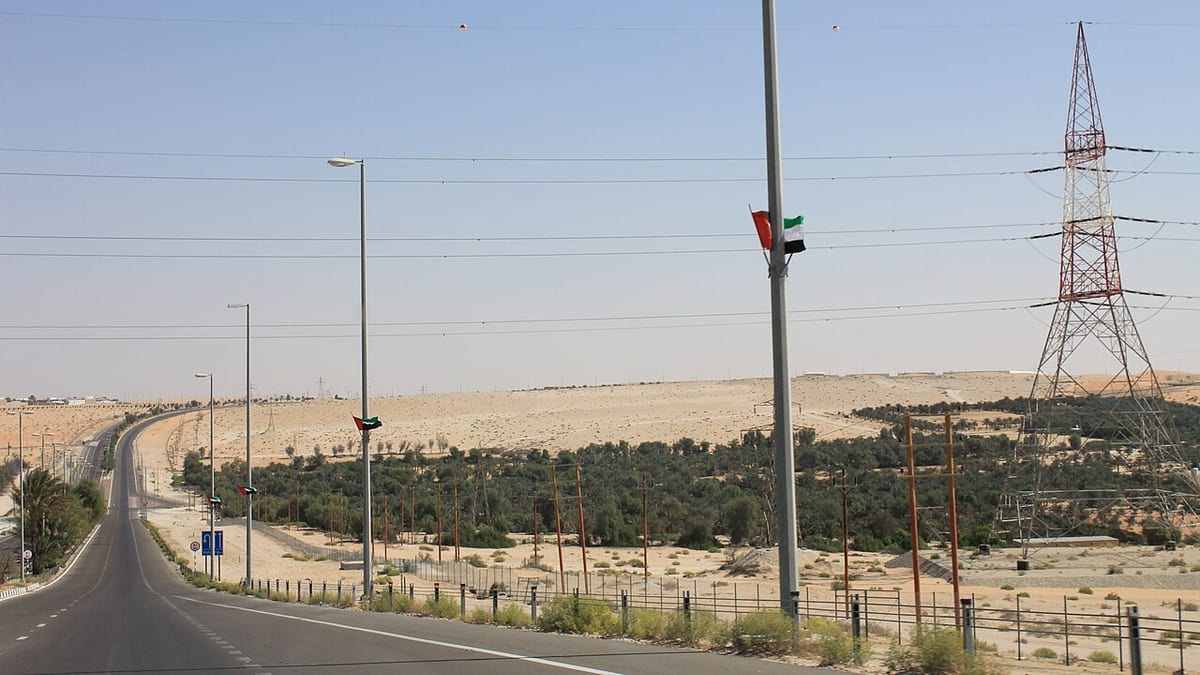
For travel from Abu Dhabi to Liwa Oasis, drive or arrange a private transfer when the dunes or a desert resort are your main destination. The public bus is the budget option for reaching the oasis settlement, but it does not solve every onward journey. Choose the exact place you want to reach before comparing fares.
Liwa is not a single attraction with one entrance. A ticket to the settlement, a hotel transfer to the Empty Quarter and a trip to Moreeb Dune can all be described as "going to Liwa," while involving different roads and substantial extra travel. Abu Dhabi's tourism authority places the general oasis journey at roughly 250 kilometres and two and a half to three hours each way. [1]
First decide which Liwa you are visiting
For a first visit, distinguish three plans: exploring around the oasis settlement, seeing the large dunes, or staying at a resort. The transport that works for one may be inconvenient for another.
Mezaira'a is the settlement named in Abu Dhabi Mobility's Capital Express timetable for Liwa. Qasr Al Sarab, by contrast, supplies its own approach through Hameem, followed by a separate access road to the resort. Treating those as interchangeable drop-off points is the mistake most likely to turn a cheap journey into an expensive one. [2][3]
Send the destination's map pin to a transfer company, not simply the word "Liwa." For a hotel booking, ask whether the quote reaches reception and includes luggage. For an outing, specify each stop and how long the driver will remain with you. A one-way taxi quotation is not automatically a sightseeing package or a guaranteed return service.
For Moreeb Dune or a festival visit, use the event's actual entrance information. Festival sites can have parking and circulation arrangements that differ from an ordinary visit to the surrounding desert. The festival organiser describes Liwa as approximately a three-hour drive from Abu Dhabi. [4]
The public bus: economical, but plan the final leg
Abu Dhabi Mobility lists the Liwa intercity fare as AED 35, with tickets available through the station's Customer Happiness Offices. Its linked Capital Express timetable identifies Mezaira'a Bus Station as the Liwa stop. [2][5]
The important limitation is not the fare: it is what happens after you get off. A bus to Mezaira'a should not be treated as a transfer to a remote camp, resort or dune viewpoint. Arrange onward transport with your accommodation or a local operator before buying a journey that depends on it.
Use the date-specific departure confirmed at the station. The timetable linked from the transport authority's page has "2024" in its filename, while the general webpage describes service frequency across the wider network. That is not enough evidence to promise that a Liwa departure runs every hour. [2][5]
For two adults, the published one-way fare produces a calculated return bus cost of AED 140, before any local taxis or transfers. That is a useful starting point, not a full excursion budget. Compare the total with a car or a door-to-door quotation once you know the price of reaching your actual destination.
Bus travel makes most sense for an overnight visitor whose host can arrange collection. It is less attractive for someone trying to fit a dune visit, sunset and a long return journey into one day. Missing the planned connection in a remote area is a different inconvenience from missing a city bus.
Driving gives you control over the day
Driving is the strongest option when you want to stop independently, carry supplies and choose your departure time. Use live navigation to the precise destination, rather than following a general route copied from a travel blog.
There are different approaches into the wider area. Qasr Al Sarab's own directions, for example, use the E11 and E65 towards Hameem before the resort access road. Those directions are useful for that property; they should not be substituted for a route to central Liwa or a festival entrance. [3]
The distinction between driving to the desert and driving on the dunes also matters. Reaching a road-accessible destination does not mean that you should continue onto sand. The festival organiser recommends a four-wheel-drive vehicle for off-road exploration, but the vehicle alone does not supply the driving skills, recovery arrangements or insurance permission that such a trip requires. [4]
For an ordinary first visit, keep your own driving on the route approved by your accommodation or activity provider, and book a guided desert activity separately. Ask the rental company what the contract permits before planning any unpaved section. Do not rely on an informal assurance that a particular car "can manage it."
Start with sufficient fuel, drinking water and a charged phone, and save the destination details offline. These are planning precautions for a long outing, not a reason to turn a straightforward road journey into an expedition.
Private transfer, taxi or organised excursion?
A private transfer is particularly useful when you are staying at a resort and will not need a vehicle during the stay. Qasr Al Sarab confirms that it offers transfers within the UAE, with arrangements depending on the vehicle selected. Obtain a current quotation directly rather than relying on a historic travel article's fare. [6]
Ask whether a transfer price includes the airport or city pickup, waiting time, taxes, child seats where needed and a return journey. A group should also confirm vehicle capacity with luggage; the number of seats is not the same as comfortable space for passengers and large suitcases.
An organised excursion is a different purchase. It can combine the drive with an activity, meals and supervision, but "desert safari from Abu Dhabi" does not necessarily mean Liwa. Require the actual itinerary and area in writing when the Empty Quarter is the reason for the trip.
For a short visit, a driver who remains with you can be more valuable than a lower one-way fare. That arrangement allows you to leave when you are ready without trying to find a vehicle after sunset.
Day trip or overnight?
Using the tourism authority's broad driving estimate, a same-day return involves roughly five to six hours on the road before sightseeing. That is why an overnight stay is usually the better choice for travelers interested in both evening and morning desert scenery. [1]
A day trip can still work when you choose one principal experience. Leave early, have lunch or a rest built into the plan, and decide the return time before starting an optional extra. Do not combine several distant desert stops merely because they all appear under the name Liwa.
An overnight itinerary should be equally deliberate: arrive with time to settle in, arrange one evening activity, then leave room for a slower morning. Confirm meal arrangements where you are staying rather than assuming that another restaurant will be close by.
Before a long excursion, review your airline's operating information and the travel advice relevant to your nationality. Current UK guidance warns that regional tensions can produce flight cancellations and other disruption. A Liwa visit is best placed between stable travel days, not immediately before a flight you cannot afford to miss. [7]
Sources
- Experience Abu Dhabi: Desert Traditions itinerary
- Abu Dhabi Mobility: Capital Express timetable
- Anantara Qasr Al Sarab: contact and arrival directions
- Liwa International Festival: plan your visit
- Abu Dhabi Mobility: intercity services
- Anantara Qasr Al Sarab: transfer information
- FCDO: UAE warnings and insurance