
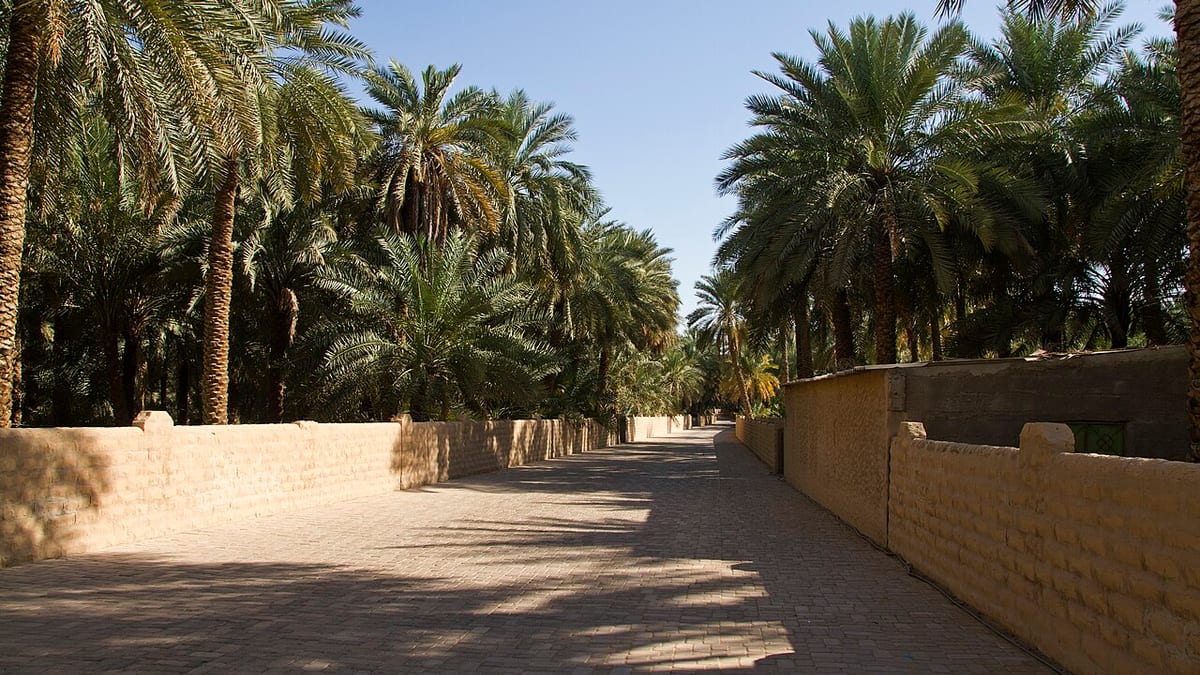
Al Ain Oasis is worth visiting for its working agricultural landscape, shaded paths and ingenious irrigation, rather than for a packed programme of attractions. Choose it when you want to understand how settlements flourished in this environment. From Abu Dhabi city, make it part of an Al Ain day trip, not a short detour between city sights. [1][2]
The important distinction is between seeing an oasis and being entertained at a landscaped attraction. A visit rewards observation: the relationship between the trees, walls, channels and cultivated plots matters more than ticking off individual photo stops. Travelers who enjoy gardens, vernacular architecture and the history of everyday life are likely to get more from it than someone seeking rides or a dramatic indoor exhibition.
What makes the oasis worth your time
Al Ain Oasis is part of the wider Cultural Sites of Al Ain World Heritage property. That designation encompasses several kinds of landscape and archaeological site, not just this one palm grove. UNESCO identifies an exceptional record of settlement and adaptation to an arid environment. Visiting the oasis gives that broader history an accessible, physical setting. [3]
Look beyond the canopy. Abu Dhabi Culture describes cultivated plots divided by historic boundary walls and supplied by wells and a network of underground and surface water channels. The two principal aflaj serving this oasis are Al Aini and Al Dawoodi. A falaj is an irrigation system; aflaj is the plural. [2]
That information changes how to walk through the site. Instead of treating a channel as a decorative stream, consider which plots it supplies and how its position relates to the paths and boundaries. The useful question is not simply "How old is this tree?" but "How does water reach the growing area, and who shares it?"
This is also a living landscape. A July 2026 municipal update describes continuing irrigation management, palm protection, maintenance and arrangements for distributing water between farms. The agricultural work is not a historical performance staged solely for visitors. [4]
Give workers space, remain on permitted routes and do not enter a cultivated plot merely because a gate is open. Those are sensible visitor practices in a working agricultural setting. The same applies to fruit: seeing dates or other produce does not make it available for picking.
Free entry does not mean every activity is free
The official visitor listing gives daily opening hours of 9am–7pm and free admission. It separately describes paid guided visits and bicycle, scooter and other rental options, with advertised rental prices starting at AED 30. The starting figure is not a promise that every vehicle or duration costs the same. [1]
A self-guided walk is the best starting choice when you want a low-cost visit and can comfortably walk outdoors. You do not need to buy an activity to justify entering. Spend the money only when it solves a real problem, such as wanting interpretation or reducing the amount of walking.
Before renting, ask what the price covers: duration, permitted route, number of users and return point. With a group, compare the total rental charge rather than a prominently advertised starting price. A vehicle that suits an adult couple may not be the appropriate option for younger children or someone with limited balance.
For illustration, four adults entering on foot pay no admission charge under the published general-entry arrangement. Their actual outing still has transport, meals and any chosen rental or guide costs. That is why the oasis can be excellent value for someone already staying in Al Ain but not automatically a cheap excursion from a distant hotel.
A better route than wandering without context
Start with orientation and, when available during your visit, the Eco-Centre. The tourism authority identifies it as the place to learn about the oasis and its sustainability practices. Then take a manageable walking route rather than trying to cover the largest possible area. [1]
For a first visit, I would reserve roughly 90 minutes to two hours for interpretation, walking and unhurried stops. That is an editorial planning allowance, not an official tour length. Shorten it in uncomfortable conditions or extend it when you have a guide and a particular interest in agriculture.
Divide that time into three purposes. First, understand the irrigation. Second, look at how the palms and other cultivation occupy the plots. Third, leave time simply to experience the quieter paths. Giving the visit those distinct purposes prevents a long walk from becoming an undirected search for a single "main attraction."
Do not judge the irrigation solely by whether a particular visible channel is flowing when you pass. The visitor authority specifically cautions that the presence of water can vary seasonally. A dry section does not establish that the whole system is abandoned, just as flowing water does not mean every plot is being watered simultaneously. [1]
Plan the journey around Al Ain, not around a map pin
Al Ain Oasis is in Al Ain, a separate city within Abu Dhabi emirate. The cultural authority places the visitor site on Al Tuhaf Street in the Central District. An "Abu Dhabi attraction" label can therefore be misleading when your hotel is in Abu Dhabi city. [2]
For a day trip, work backwards from the time you want to reach the oasis. Add your actual hotel-to-site journey, a meal break and the return journey before adding other attractions. A route planner showing a driving time does not include collecting a rental car, finding the entrance or waiting for companions.
With a driver, agree the precise pickup point and whether waiting is included. With a tour, examine how much time is allocated inside the oasis. A brief photo stop and a guided explanation of the irrigation are substantially different experiences, even when both appear under the same attraction name.
Avoid building the entire day from short stops across a long list of sites. Choose the oasis as one of the day's main experiences, then add another attraction only if the resulting schedule still leaves time to walk without watching the clock. The oasis is less rewarding when its main purpose becomes proving that you have been there.
Who should choose a different outing
Shade should not be confused with air conditioning. Treat this as an outdoor visit: carry drinking water, use sun protection and plan an exit before anyone in the group becomes exhausted. On a very hot day, a shorter visit can be the better visit. Do not use the palm canopy as a reason to dismiss the weather.
Visitors needing a reliably step-free route should ask about the specific entrance, path and available mobility options before making the journey. A general statement that bicycles or buggies are available does not establish wheelchair accessibility or guarantee assistance.
The oasis is also not an obvious substitute for a children's playground. For a family, make the walk concrete: trace a water channel, notice differences between planted areas and look at how shade changes along the route. Leave before curiosity turns into endurance.
Choose Al Ain Oasis when the landscape itself interests you. Skip a dedicated long-distance excursion when you mainly want shopping, a large indoor attraction or a tightly programmed activity. Its value lies in understanding a working place, not in how many attractions can be purchased inside it.