The Founder's Memorial is worth visiting for public art, a quieter evening outing and an introduction to Sheikh Zayed's place in the UAE's national story. Choose it as a focused stop rather than a substitute for a major museum. Entry is free, but the most rewarding visit involves more than photographing the illuminated portrait from the pavement. [1]
The distinction matters when you are allocating limited sightseeing time. This is a commemorative landscape built around one person and one striking artwork. My recommendation is to give it an unhurried hour, preferably extending from daylight into darkness, rather than expecting enough indoor exhibits to occupy an afternoon.
What you are actually coming to see
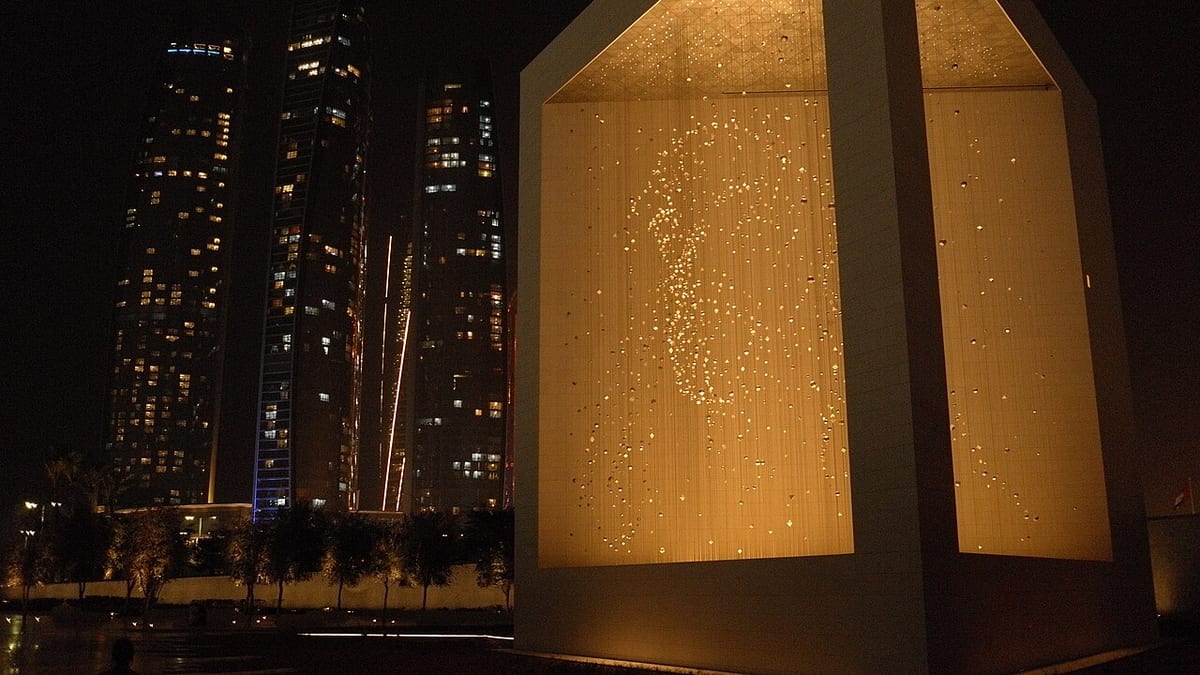
The centrepiece, The Constellation, is Ralph Helmick's suspended portrait of Sheikh Zayed bin Sultan Al Nahyan. The artist describes an arrangement of 1,327 geometric elements on 1,110 cables. Those pieces collectively form a likeness rather than a conventional solid statue. [3]
That construction gives you something to do, not merely something to identify. Begin with a view in which the face is legible, then move sideways and notice the relationship between individual components and the whole. Resist the temptation to treat the first recognisable photograph as the end of the visit. Looking from another position is part of understanding the work.
A useful question for children is, "When does this collection of shapes become a face?" It offers a way into the sculpture without requiring a long history lesson. For adults interested in design, the relationship between suspension, empty space and recognition is likely to be more engaging than collecting another landmark photograph.
The official cultural account describes the installation as a national tribute. Read its interpretation in that spirit: it presents Sheikh Zayed's life and values through a commemorative lens. It should not be mistaken for a comprehensive, competing-perspectives history of the Emirates. [2]
Start with the context, then go outside
The Welcome Centre contains footage, interviews and personal recollections. Outside, the Sanctuary Garden, Heritage Garden and Elevated Walkway provide different parts of the visit. Abu Dhabi's culture authority recommends beginning at the centre before exploring the grounds. [2]
That sequence makes particular sense for a first-time visitor who recognises Sheikh Zayed's name but knows little else about him. Give yourself a specific question to answer indoors: what ideas does this memorial associate with its subject, and how does the artwork express them? You can then connect the interpretation with what you see outside rather than reading every panel without a framework.
Conversely, an art-focused visitor need not turn the outing into a detailed biographical study. A short introduction followed by careful looking can be a coherent visit. The goal is not to exhaust every available element; it is to understand why this particular work occupies this particular public space.
There are complimentary, approximately 30-minute cultural tours in Arabic and English. The tourism authority distinguishes ordinary entry from a guided visit: individuals and small groups need not reserve general admission, while cultural tours and larger groups should be booked ahead. Free admission therefore does not mean a guide will be waiting whenever you arrive. [1]
For a family or visiting group, an organised tour is a sensible way to make the stop more substantial. Confirm its starting time before arranging dinner or another timed attraction. Do not build a tightly packed schedule around the assumption that an unscheduled guide will immediately become available.
Daylight or after dark?
The cultural authority describes the suspended elements lighting up at night, giving The Constellation its star-like appearance. Day and evening are therefore different experiences of the same artwork, not simply different levels of photographic brightness. [2]
I would choose a late-afternoon arrival when the weather is comfortable enough for time outdoors. Use the earlier part for interpretation and the gardens, then revisit the sculpture as its illumination becomes prominent. This recommendation is about seeing a transition, not about a guaranteed sunset effect or an exact daily lighting time.
A purely evening visit works well when you chiefly want the illuminated installation. A daylight visit is a stronger choice when examining the construction and landscape matters more to you than the night-time atmosphere. Neither requires booking a second visit just to satisfy a checklist.
For photography, first decide whether the portrait or its setting is your subject. Try a wider composition showing the suspended structure before moving to a tighter view of the face. Watch the image on your screen rather than assuming a brighter exposure will improve it: preserving the difference between lit elements and surrounding darkness may communicate the idea more clearly.
Allow flexibility for other visitors. A public memorial is not a private photo set, and getting a clean composition is less important than leaving circulation routes comfortable for everyone.
Hours, arrival and the realistic time commitment
Published opening hours are daily from 9am to 10pm. The site is in Al Ras Al Akhdar on the Corniche side of Abu Dhabi. [1] Treat the hour before closing as a limited visit rather than arriving then expecting the complete guided experience.
The culture authority identifies limited free visitor parking and the taxi drop-off on 18th Street, beside the Welcome Centre. Pedestrians can also enter from the Corniche. [2] Use that entrance information when requesting a ride; the correct arrival point is more useful than asking a driver to stop wherever the sculpture first comes into view.
For planning, allocate around 60–90 minutes for interpretation, a leisurely walk and two different views of the artwork. That is an editorial allowance, not a measured visitor average. Add travel time separately, and do not interpret limited free parking as a guaranteed space during your chosen visit.
A shortened outing can still be worthwhile, but make the trade-off deliberately. With only half an hour available, choose between a concentrated look at the sculpture and a more explanatory visit rather than rushing both. Someone who wants substantial guided context should reserve that experience and protect the time for it.
Who should make room for it?
Put the memorial on your itinerary when you enjoy sculpture, landscape design or reflective public spaces, or when a free evening activity would balance more expensive attractions. It also suits a group whose members have different interests: one can engage with the interpretation while another concentrates on the artwork.
Give it lower priority when you have only a very short stopover and your main ambition is a major art collection, a full historical museum or a long indoor activity. Its value lies in focus, not volume. Plan it for the experience it offers - a national memorial, interpreted through a distinctive work of art - and it makes a more convincing visit than a hurried extra stop between unrelated bookings.